






You Already Run a Haulage Company Abroad: A Polish Company Alone Does Not Move It
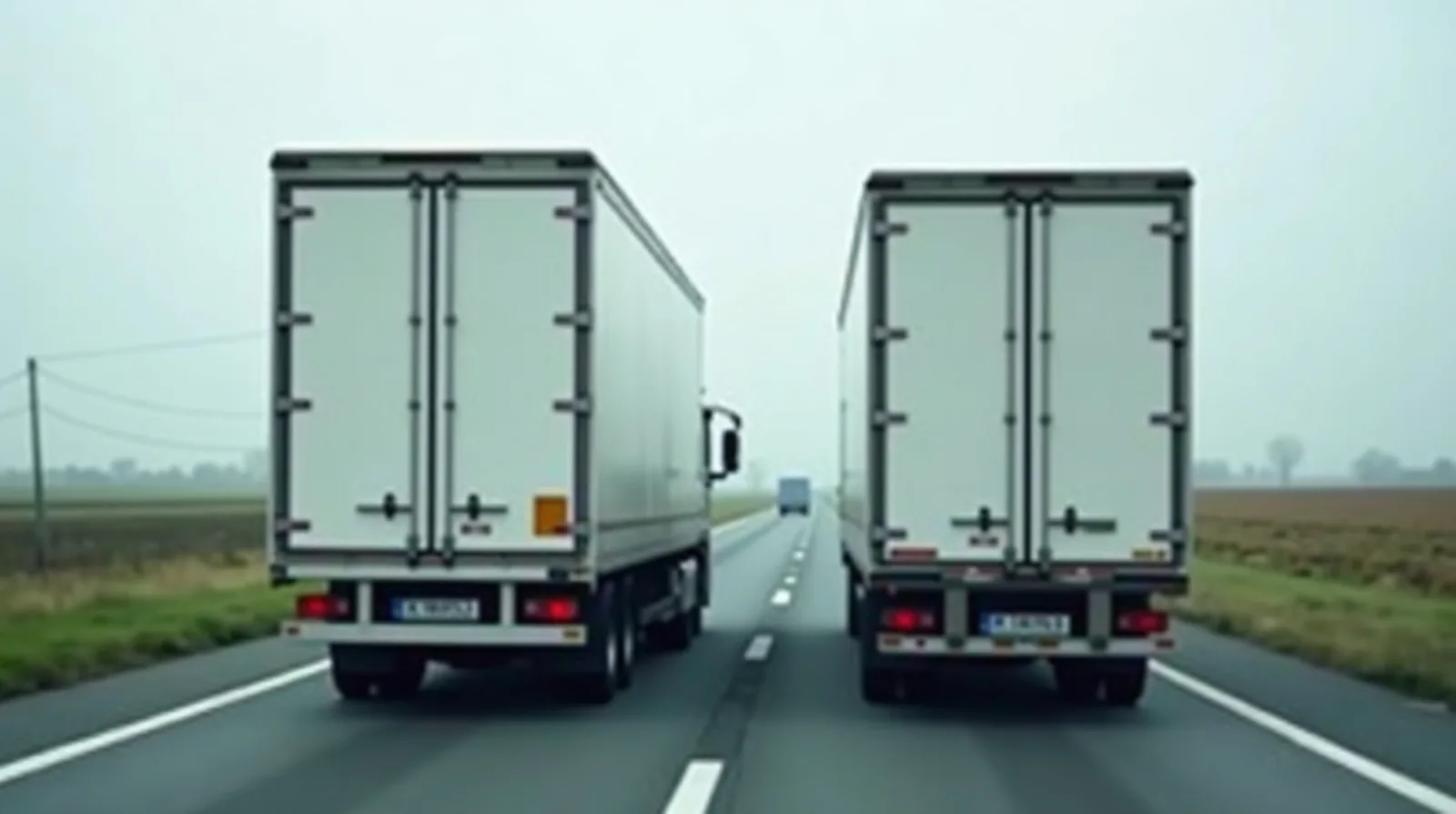
Hauliers in Germany, Belgium and the Netherlands look at Poland for one reason: the same EU market, more manageable operating costs, and a base in the middle of the east–west corridor.
And this is exactly where the most common mistake starts. Registering a Polish sp. z o.o. does not move your operation to Poland. A transport licence follows where the business is actually carried out, not where the company is filed.
The rule: the licence follows reality, not paperwork
Since 21 February 2022, Regulation (EC) 1071/2009 defines “effective and stable establishment” far more concretely. To hold a Polish licence, the following must genuinely be in Poland:
- An operating base (baza eksploatacyjna) — a physical site with parking. Parking is required for one third of the declared vehicles (up to 2 vehicles, one space is enough).
- Vehicles — at the company’s disposal and registered and put into service under that Member State’s rules.
- Drivers — normally based at that operating centre, in proportion to the scale of operations.
- Administrative and commercial activity — carried out with real equipment, on premises the company controls.
- Original documents — transport contracts, vehicle documents, accounting records and personnel files accessible at the establishment.
That list is not an accident. The Mobility Package was written specifically to shut down letterbox companies.
You do not have to close the German company
This is the most common misunderstanding. The two structures can run in parallel: the German GmbH continues with its own licence and fleet, while the Polish sp. z o.o. operates on its own licence, its own base and its own vehicles. Ownership can be shared — but the licences are separate, and each must satisfy its own country’s conditions on its own merits.
So the question is not “which one”. It is “what am I actually going to build on the Polish side”.
Sp. z o.o. or a branch (oddział)?
A foreign company can open a branch in Poland. But a branch is not a separate legal entity, and it does not make the operator authorisation easier — the base, vehicle and driver requirements apply in exactly the same way.
In practice carriers set up a sp. z o.o.: liability is separated, the financial standing calculation stays clean, and leasing and freight-exchange onboarding run without friction. A branch can make sense for other purposes, but it does not soften the licence requirement.
What inspections actually look for
GITD looks for letterbox structures, and the indicators are standard: no vehicles ever seen at the base, all drivers located in another country, documents not held at the establishment, the address resolving to a virtual office.
The consequence is not only a fine. Serious infringements are recorded in KREPTD and they accumulate; loss of good repute leads to withdrawal of the licence. Paying the fine does not erase the entry.
Know what changed by 2026
- The obligation for vehicles to return to base every 8 weeks is gone. The CJEU annulled it on 4 October 2024 — on procedural grounds (no adequate impact assessment), not on the merits. It does not apply today.
- Drivers must still return to the operating centre or their residence every three to four weeks.
- Posting rules still apply to cabotage and cross-trade. Bilateral operations remain exempt.
- Cabotage limit: 3 operations within 7 days, then a 4-day cooling-off period in that country.
A realistic sequence
- Incorporate the sp. z o.o. — 250 PLN state fee via S24, a few days
- Operating base — including parking; the lease or use agreement must be in your company’s name
- Financial standing — €9,000 for the first vehicle, €5,000 for each additional one
- Appoint a transport manager holding a CPC
- Operator authorisation (1,000 PLN) + Community licence (up to 10 years, 8,000 PLN) + a certified copy per vehicle (880 PLN)
- Register the vehicles in Poland, open an e-TOLL account, arrange insurance
Steps 2 and 4 are what take the time — not the incorporation. Planning the whole thing as “a few weeks” is not realistic.
Where Meyis fits
Incorporation, arranging the operating base, the licence application, accounting and payroll run through one point of contact. We arrange the base through partner yards — we do not operate the yard ourselves; the lease is made out directly to your company, because the licence application requires the legal title to sit with your company.
We work regularly with carriers coming from Germany, Belgium and the Netherlands. The structure can be built without interrupting your existing operation.
Related reading
Frequently asked questions
- Do I have to close my German haulage company?
- No. The two companies can run in parallel, each with its own licence, its own operating base and its own vehicles in its own country. Ownership can be shared, but each licence must meet its own conditions independently.
- Can my trucks keep their German plates?
- For a Polish licence, vehicles are expected to be at the company's disposal and registered under Polish rules. Keeping the entire fleet abroad is treated as a classic letterbox indicator during an inspection.
- Do I need to live in Poland or hold a residence permit?
- No. Shareholders do not need to reside in Poland. But the company's activity — base, vehicles, drivers and documents — must genuinely be in Poland.
- Can I get a transport licence with a virtual office address?
- No. A virtual office can be used for the KRS registration of the company, but it does not satisfy the operating base requirement. The licence requires a physical site with parking.
- Do vehicles still have to return to Poland every 8 weeks?
- No. The CJEU annulled that obligation in its judgment of 4 October 2024 and it is not in force. The separate obligation for drivers to return to the base or their residence every three to four weeks does still apply.
- How long does the whole process take?
- The company itself is incorporated within a few days via S24. What extends the timeline is the operating base, financial standing and the transport manager. Plan in months, not weeks.